
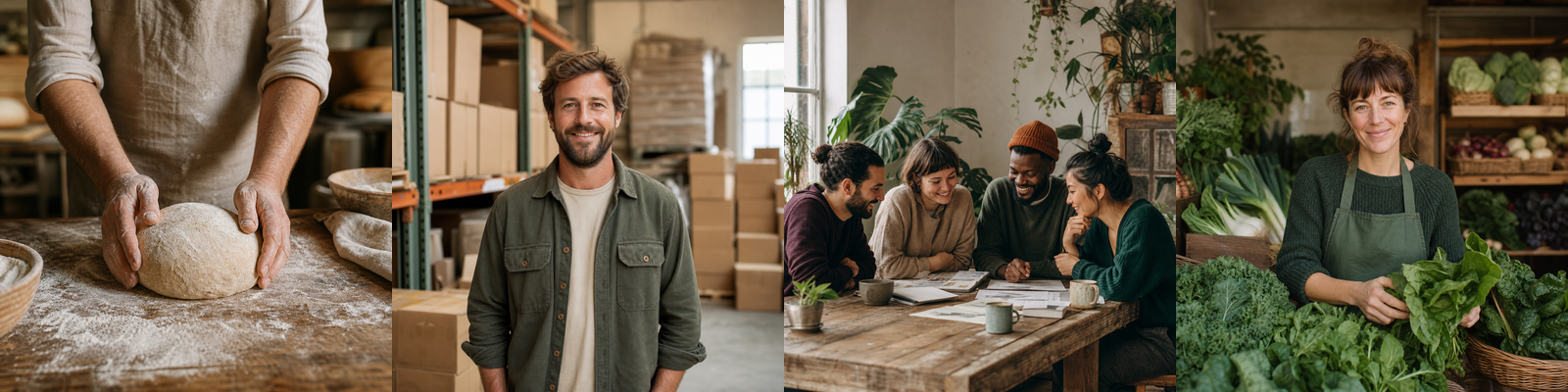
The maker
You build something worth bringing to market.
A guide to independent retail
Meet the local operators, regional networks, and trusted distributors that give emerging brands a meaningful way in.
Local knowledge. Shared buying power. Better introductions.
Who holds the door open
You build something worth bringing to market.
You connect makers to stores at scale.
You aggregate volume and amplify local impact.
You choose what your community can trust.
The fundamentals
Independent retail is not a single buyer — it is a channel of locally owned operators served by shared wholesalers and buying groups. Four frames orient an emerging brand before it sells in.

01
Locally owned grocery stores, specialty retailers, and community-based operators — distinct from national chains, with different decision-makers and economics.
02
The Independent Grocers Alliance is a network of independently owned supermarkets operating under a shared brand and supply system, supported by wholesalers and buying groups.
03
Regional cooperatives and distributor-led groups aggregate purchasing power, marketing, and logistics — making them critical gateways for brands seeking scalable entry into independent retail.
04
Independent operators move faster than chain category reviews, support local stories, and reward brands that fit the community shelf rather than the planogram.
Where the buyers sit
Most independent placements come through one of five entry points. Knowing which one fits your brand is the first decision before any pitch deck.
01
Independently owned supermarkets operating under the IGA banner and shared supply system — reached through their supporting wholesalers.
02
Member-owned co-ops that aggregate purchasing, marketing, and logistics across a region — often the fastest route to a footprint of stores.
03
Buying groups organized by independent distributors that present aggregated demand to brands and aggregated assortment to operators.
04
Locally owned specialty, natural, and gourmet retailers — typically reached through specialty distributors and regional brokers.
05
Single-store and small-chain community operators that anchor neighborhoods — often a brand's first proof point before a buying-group conversation.
Channel stack
A pitch aimed at the wrong layer stalls. The right entry sequence reads the full stack — store, banner, distributor, buying group — and starts where the decision actually lives.
Locally owned grocery and specialty operators — the actual shelf and the community trust behind it.
IGA and similar shared-brand systems that align independent stores under a common identity and supply program.
The supply layer that physically reaches independent stores — often the gatekeeper on what gets carried at scale.
The aggregated purchasing layer where brand introductions happen across many stores at once instead of one at a time.
Independent retail looks fragmented from the outside — but underneath sits a small set of buying groups, distributors, and shared-brand systems that make scalable entry possible for emerging brands.
IndependentRetailing.com · channel curriculum
Practical process
Identify the IGA-aligned, co-op, and independent operators in your priority regions — and the wholesalers and buying groups that supply them.
Decide whether your brand starts with a community operator for proof, a specialty distributor for assortment fit, or a buying-group introduction for footprint.
Translate brand story, margin structure, velocity expectations, and merchandising support into the format the buying group or wholesaler actually reviews.
Use the channel network to secure the introduction to the right buying-group or wholesaler buyer — independents reward brands that arrive credentialed, not cold.
Independents notice service. Plan local merchandising, demos, in-store presence, and reorder discipline before you scale to the next region.
Sister channels
If your brand belongs in independent cafés as well as on the independent shelf, this is where that channel gets introduced.
Visit siteAdjacent channel access for brands looking past independent grocery into commissary and exchange systems.
Visit siteCommunity-operator channel for brands whose story lands with civic and first-responder audiences alongside independent grocery.
Visit siteThe parent network that connects emerging brands across every channel-access site in the group.
Visit siteReview notes
IndependentRetailing.com introduces new opportunities for startup and emerging brands to access the independent retail channel—connecting with locally owned grocery stores, specialty retailers, and community-based operators through established distributor and buying group networks. Definition: IGA (Independent Grocers Alliance) stores are independently owned supermarkets operating under a shared brand and supply system, supported by wholesalers and buying groups; similar networks (such as regional cooperatives and distributor-led groups) aggregate purchasing power, marketing, and logistics—making them critical gateways for brands seeking scalable entry into independent retail.
Get the introduction
Send your brand snapshot, target regions, current distribution, and the wholesalers or buying groups you have already engaged. The channel team returns a routing recommendation and the right introduction to start with.
Email the channel team